Call Us: +261 34 05 671 41
Looking for Sponsors & Funding
Analalava Project
Thirty-Well Program to benefit 15,000 people who have never had clean water
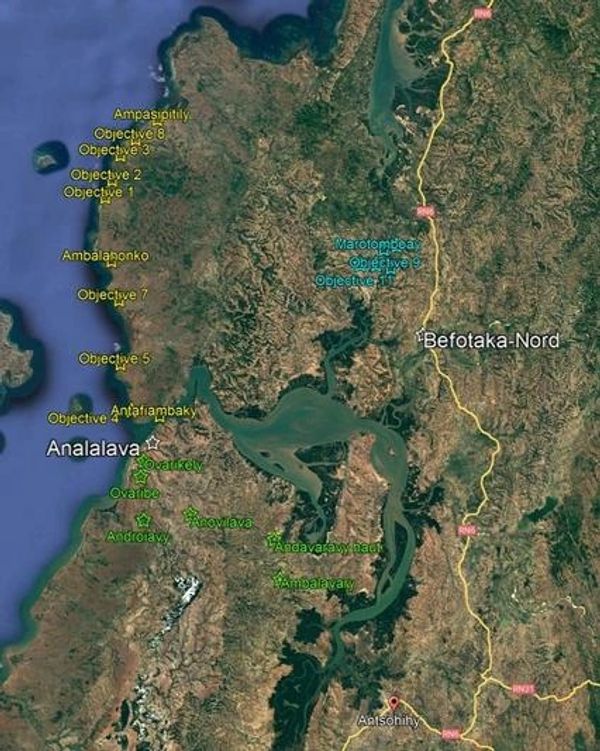
The Analalava Project includes three separate areas in the coastal area of Northwest Madagascar. It is a very rural area that has been ignored in every aid program since time immemorial because it is difficult, but not impossible, to access. Villages range in size from a few hundred to just over a thousand people, and all lack reasonable access to fresh water. All areas are accessible by crude roads during the dry season.
Area 1: Region of Sofia | Commune of Analalava
The villages in the Commune of Analalava lie along the inland waters of the Louva River. None have ever seen a well, and during the dry season, the villagers dig holes in dry riverbeds to get water—shameful in the 21st century!
Area 2: Region of Sofia | Commune of Ambolobozo
Sixteen years ago, I visited the coastal villages north of Analalava. There were no wells or infrastructure then, and it is the same today. The villagers' attempts to help themselves have failed because they lack good technical advice. High tides and mangroves are common to the NW coast, causing the nearshore aquifers to be salty. One must go inland several hundred meters or more to access freshwater aquifers.
Area 3: Region of Sofia | Commune of Befotaka Nord
This area between the coast and RN 6 is home to many thousands living in small villages of several hundred. They have never received any help to provide clean, fresh water and use seasonally dry streams to get water.

Mini Municipal Water Systems
The Madagascar Water Project is adopting, in part, a more modern water development model where a water distribution system sourced from a high-rate well provides safe water to the entire village. It reduces the geologic risks of drilling multiple wells, makes water more accessible to more people, requires less maintenance & repairs, and encourages the villagers to use it freely for all their home and personal needs.
Small Investment, Big Reach
After drilling a qualifying source well, the incremental costs to build a water distribution system are about $3k + $1k per water stand. This is the same model USAID and UNICEF have adopted at a very small fraction of the cost. The attached photos show two villages that already have qualifying wells, including one that will be developed this month. Several more will be added this month in the Mahanoro area as shown on the Current Activity Tab. Each well will be completed as a hand pump until we get funding to build the larger infrastructure.
Miakara
Miakara is a large village of 1500 located just outside Mahanoro. The Pangalana Channel is the primary source of water. Three shallow water wells remain unused because of the high iron content and foul odor.
The Madagascar Water Project drilled a well to 24 meters in March 2024. It tested clean, odorless water at a rate of 3k liters per hour and is currently equipped with an Indian Mark III hand pump. The anticipated water distribution system has not been designed in detail but is expected to have 6 water stations costing approximately $6k—8k.

Niarovanivolo
“Sometimes I think that they have forgotten about us.”
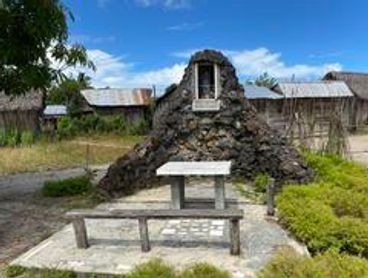
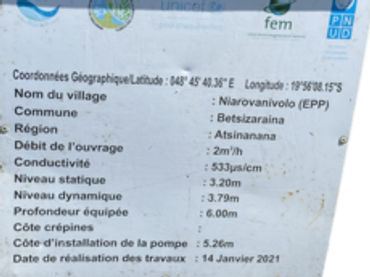
These are the words of one of the officials in the village of Niarovanivolo. The childhood home of one of Madagascar’s past presidents, Didier Ratsiraka, is a village of 3000 people that is several kilometers off the main road near Betsizaraina. This isolation has caused it to be ignored by every significant water project since time immemorial. Only in 2021 did UNICEF drill one hand pump well in the schoolyard, which still produces clean, fresh water.
A Well of Hope
The Madagascar Water Project plans to drill two qualifying wells to supply a mini-municipal water system for the entire village. With your support, this village will get the clean water it never had.